
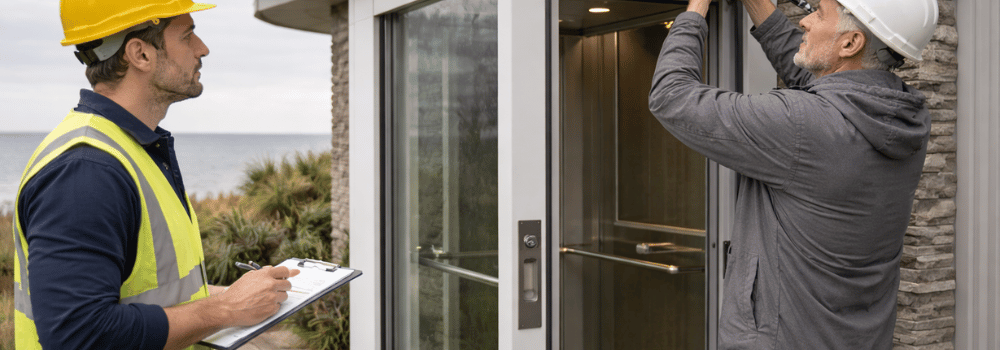
An outdoor home elevator remains exposed to rain, wind and temperature movement throughout its service life. Without proper structural sealing and drainage control, water ingress can reach lower fixings, base plates and control enclosures, accelerating corrosion that compromises reliability over time. Builders must treat weatherproofing as a core structural consideration, not a finishing detail.
Plan coordination early to protect performance and avoid disrupting finished construction.
What Is Required to Weatherproof an Outdoor Home Elevator?
Getting weatherproofing right for an outdoor home elevator depends on how you coordinate structure, enclosure detailing and drainage from the outset.
At a minimum, this includes:
- A weather-resistant shaft or enclosure strategy
- Controlled drainage at base level
- Proper sealing at slab and façade interfaces
- Corrosion-resistant materials and fixings
- Electrical components suitable for external conditions
Address external lift exposure during design development. Where a shaft penetrates an external wall or sits against a façade, resolve detailing before cladding is fixed and ensure the interface prevents water ingress.
Control drainage at roof junctions and base thresholds so moisture does not migrate into structural connections. Provide fall direction, protect base fixings and use appropriate membranes to prevent standing water.
Install electrical and control systems in suitably rated enclosures and seal cable entries correctly. Incomplete sealing increases condensation risk and accelerates corrosion over time.
In many residential settings, internal lift installations simplify weather protection and structural integration. Where external installation becomes necessary, Morgan Ellis can advise on suitable system selection and retrofit strategies, even within complex properties.
Contact Morgan Ellis to review feasibility and exposure considerations at early design stage.
How Does UK Weather Affect an Outdoor Home Elevator?
UK conditions expose external lift installations to persistent moisture and temperature movement.
Frequent rainfall increases the likelihood of water tracking into poorly sealed joints. Wind-driven rain can penetrate façade interfaces if detailing lacks tolerance. Freeze–thaw cycles introduce expansion and contraction within exposed materials. Temperature variation affects both structural elements and enclosure panels.
In coastal or riverside locations, airborne salt accelerates corrosion, particularly in exposed coastal installations where wind can carry salt-laden moisture onto external steelwork. Specify external guide rails, brackets and fixings in suitable grades of stainless steel or apply protective coatings to maintain durability.
Builders planning an outdoor home elevator in the UK must assess exposure conditions at that site. Urban courtyard conditions differ significantly from open rural or coastal settings.
Failure does not usually happen overnight. Deterioration develops gradually through corrosion or water ingress, often first visible at lower brackets or threshold edges. Visible staining or corrosion at handover stage can undermine perceived build quality and trigger remedial inspection.
When Should Structural Planning Start for an Outdoor Home Elevator?
External installations introduce structural issues that internal lifts reduce or avoid.
External shafts experience wind loading and thermal movement that must be absorbed without transferring stress into surrounding façade finishes or cracking sealant lines along vertical joints. Fixings must accommodate these forces through appropriate anchoring methodology and tolerance allowances. Avoid rigid connections that compromise envelope integrity. Where lifts attach to existing structures during renovation, engineers must assess load paths and reinforcement requirements.
Early structural coordination enables design teams to confirm anchoring strategy and protect façade integrity before reinforcement becomes necessary.
Introducing an external lift after façade works or cladding installation often requires modifying finished structure and reopening sealed envelope junctions. This places additional pressure on programme timelines close to completion and can require reopening walls or altering envelope detailing that clients expect to remain untouched. Late structural amendments at this stage increase cost exposure and delay risk close to handover. Plan integration before envelope works progress to avoid these complications.
How Do You Integrate an Outdoor Home Elevator Without Affecting Façade Design?
External lift installations must align with the architectural character of the property.
Builders and designers can maintain cohesion by:
- Matching enclosure materials with façade finishes
- Coordinating glazing with window systems
- Concealing drainage within façade lines
- Maintaining consistent proportions
In high-value residential schemes, visible additions attract scrutiny. A poorly integrated outdoor home elevator can disrupt façade balance or introduce visual clutter.
Where projects involve luxury renovations, designers may incorporate an external shaft to preserve internal layout. In these cases, material choice and detailing determine whether the lift appears integrated or appended.
Do Outdoor Home Elevators Require Specific Weather or IP Protection Standards?
Outdoor installations must align with manufacturer environmental ratings and the ingress protection (IP) ratings specified for exposed components and enclosures. Confirm that electrical components, control panels and external connections meet suitable IP ratings for site conditions before procurement.
Failure to match specification to site conditions can lead to premature component deterioration and commissioning issues.
Which Residential Lift Systems Suit External Installations?
Not every residential lift system adapts equally well to external conditions. Shaft-based lifts installed within purpose-built enclosures often provide greater control over weather protection and interface detailing, such as those found within the Aritco range. Self-contained systems require careful assessment of exposure, enclosure design and environmental rating before specification, including options such as pneumatic vacuum elevators.
Select lift systems with environmental suitability in mind, and align product choice with structural context, façade integration strategy and site conditions.
Can an Outdoor Home Elevator Be Added During a Luxury Renovation?
Luxury renovations introduce structural constraints that demand careful coordination.
Where internal reconfiguration proves impractical, design teams may consider an external shaft to introduce vertical access without compromising principal rooms. In these scenarios, builders must coordinate structural reinforcement, façade integration and weatherproof detailing simultaneously.
Retrofitting an outdoor home elevator demands careful evaluation of existing structure, envelope condition, anchoring capacity and exposure level before penetration works begin, particularly where existing façades lack clear structural backing at fixing points. Conduct site surveys and obtain early engineering input before installation progresses to reduce uncertainty.
How Morgan Ellis Approaches Externally Exposed Lift Installations
Morgan Ellis engages at early RIBA stages when projects involve external or exposed lift conditions, aligning with the structured approach outlined in the process of buying a home lift. The team reviews structural interfaces, anchoring methodology, penetration detailing and environmental exposure alongside structural engineers and façade consultants before envelope works and technical details are finalised.
Coordination focuses on structural anchoring, interface detailing and moisture management.
Where an outdoor home elevator forms part of a new build or luxury renovation, engage early to align structural design with lift specification.
Contact Morgan Ellis to discuss project-specific exposure requirements and review suitable system options.