
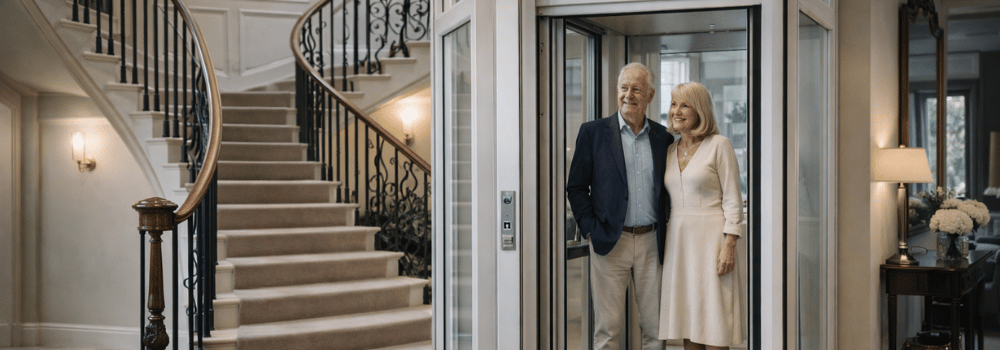
The grand staircase used to carry a clear message in a high-value home. It showed scale, confidence, and a willingness to give prime space to a single architectural feature. In many period and luxury properties, it shaped the whole arrival experience.
Homeowners still want impact, but they also want homes that work well for longer, support daily movement with less effort, and fit modern expectations around comfort, access, and long-term living. That is why luxury home lifts now appear in more serious renovation and new-build discussions. They answer a practical need, but they also support a cleaner and more considered design direction.
So are they replacing the grand staircase? In some homes, yes, in part. In others, they are changing its role. The staircase is no longer the only way to signal quality, and in many properties it is no longer the smartest place to concentrate space, budget, and architectural emphasis.
Why this question matters more in 2026
This shift is not only about taste. It reflects how people now use their homes.
Many high-end clients want a property that supports them for the long term. They may be planning a major renovation for a forever home. They may want better movement between floors for family members or guests. They may also want to protect the future value of the property by making it easier to live in as needs change. In that setting, a lift is no longer a niche addition. It becomes part of the main design conversation.
UK building guidance has also helped shape wider awareness around access and adaptable homes. Approved Document M for dwellings sets out the framework around visitable, accessible, and wheelchair user homes, and that has helped make long-term usability a more familiar part of residential planning.
That does not mean every luxury home now needs a lift. It means more clients now see good access planning as part of good design.
The staircase still has value, but it no longer leads every scheme
A staircase can still be the right choice as the main architectural feature. In the right property, it can give shape to an entrance hall and provide a strong visual route through the house. That remains true.
The difference is that clients now ask more of every design decision. They want to know how a feature will affect space planning, day-to-day movement, later-life comfort, and resale appeal. A staircase that takes up a large footprint must justify that footprint. A circulation strategy that relies only on stairs must work for the people who will live there now and later.
Luxury home lifts offer a different kind of value. They can free up planning options, support easier movement through the home, and sit within a design scheme with far less visual disruption than older domestic lift models often created.
Why lifts now feel appropriate in luxury design
Part of the change comes from product quality. Domestic lifts now look far more resolved than they did in the past. A well-specified model can sit comfortably in a high-end interior, with control over finishes, glazing, configuration, and how the lift aligns with joinery, flooring, and surrounding space.
That means the lift no longer reads as a compromise. It can read as a sensible and refined design decision.
The source article you shared makes a practical point that supports this. Replacing stairs with a lift can be possible in some homes, but the outcome depends on layout, structure, regulations, and safe means of movement through the property. That is the right framing for this topic. The real issue is not fashion. The real issue is how to create the best movement strategy for the home.
Morgan Ellis fits naturally into that conversation because the service goes beyond supplying a lift model. The value sits in choosing the right system, planning the right position, coordinating it with the wider scheme, and making sure the result looks intentional from day one.
What modern prestige looks like now
Prestige in a home used to lean more heavily on visible statement features. It now includes how well the house works in private.
Clients still care about form. They still care about materials, proportion, and atmosphere. But they also care about ease. They want less friction in daily life. They want a home that still feels right in ten or fifteen years. They want to avoid a future retrofit that feels forced or visually disconnected from the rest of the property.
That is why luxury home lifts now align so well with luxury renovations. They support a future-facing way of thinking without pushing the home into a clinical or purely functional direction. They make it easier to move through the property and easier to plan for long-term use, while still respecting the design brief.
A better way to plan the layout
If you are reviewing a renovation or new-build layout, this is the stage to speak with Morgan Ellis. Early lift planning gives you more control over placement, structure, circulation, and the visual result. It also helps avoid a late design change that can compromise the plan. A conversation at concept stage can make the whole scheme read more clearly and function more smoothly.
Are lifts fully replacing stairs?
For many high-end properties, the stronger solution is not a full replacement. It is a better balance. The staircase may stay, but with less pressure to do all the work. The lift handles practical movement between floors, while the staircase takes a quieter architectural role. In some projects, the staircase becomes more compact. In others, the lift becomes the cleaner organising feature, and the staircase moves out of the spotlight.
The inspiration article supports this position. It states that replacing stairs with a lift can be done in some cases, but it is not a universal route and depends on structural and regulatory factors. That matters because readers need a realistic answer, not a fashionable one.
Where a lift should sit in the design process
That is one of the clearest practical conclusions from both design experience and the source material. If a lift enters the discussion after the layout is fixed, the result is often more constrained. The options for placement narrow, the structure may need more adjustment, and the visual integration can become harder to resolve.
On the flip side, when the lift forms part of the initial planning conversation, the design team can think clearly about footprint, travel path, room relationships, access points, and how the lift complements the rest of the interior. That is where we ad real value. The service connects design intent with technical planning, so the lift feels like part of the property rather than a later insertion.
What this change means for architects and designers
For architects and interior designers, this trend opens a wider design vocabulary.
A staircase always asks for visual attention. A lift can be handled in a much more controlled way. It can become a feature if the scheme calls for it, or it can sit quietly within the plan and let other architectural elements lead. That flexibility makes it easier to match the circulation strategy to the overall character of the home.
It also creates more freedom in luxury renovations where space may be limited, the property may need better long-term usability, or the client wants a cleaner interior with fewer dominant structural gestures. In those settings, luxury home lifts can support the design concept without competing with it.
Planning the right next step
If your project involves a renovation, a new build, or a home designed for long-term living, we can help you assess the right lift type, the right placement, and the right level of visual integration for the property. That advice is most valuable when it comes in early, before layout decisions harden and before compromises start to shape the scheme. Contact us to discuss the property, the design intent, and the best route to a lift solution that fits the home properly.