
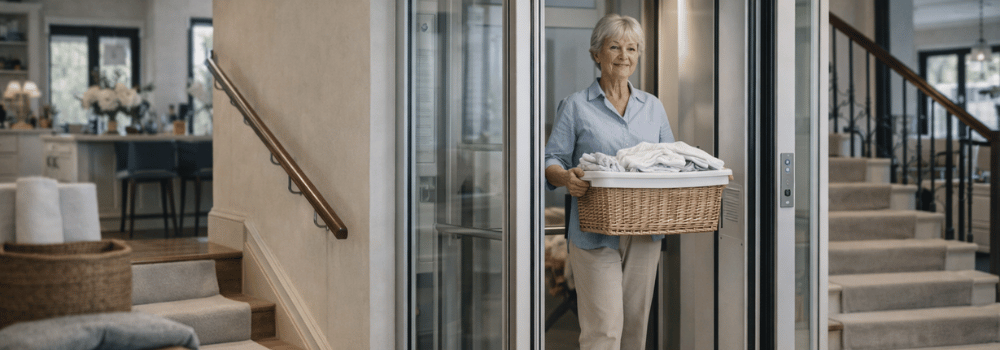
A busy household creates constant movement. Shopping comes in through the front door and needs to reach the kitchen. Laundry moves from bedroom to utility area and back again. Suitcases come down before a trip. Children, bags, coats, and everyday items move between floors all day. In a multi-storey property, those repeated trips can place extra pressure on routines that already feel full.
That pressure often goes unnoticed because it looks normal. You carry one load upstairs, then go back for the next. You leave a task until later because it means another round of stair trips. You start planning around effort instead of moving through the house in the most direct way. Over time, that affects how efficiently the home works.
Home lifts reduce that friction. They make movement between floors simpler, faster, and less physically demanding. For households that want the home to feel calm, well planned, and easy to use, that change has real value.
This is one reason lifts now sit more naturally within design-led homes. Morgan Ellis positions its offer around bespoke residential lift solutions for luxury homes, renovations, and new builds, with consultation, installation support, and architectural integration all part of the process. The company also presents lifts as part of the home’s design and long-term function, not as an afterthought.
Why daily routines start to feel harder in a multi-storey home
Most daily strain does not come from one major task. It comes from repetition. A staircase works well until the number of journeys starts adding up. Morning routines involve moving between bedrooms, bathrooms, kitchens, and dressing areas. During the day, household jobs create more trips. In the evening, the same pattern begins again.
That matters in larger homes because each routine takes longer to complete. A task that looks simple on paper can involve several separate journeys with awkward or heavy items. Groceries, cleaning equipment, bedding, parcels, school bags, and luggage all add to the workload. When those jobs sit across different floors, the house can start to slow you down.
Home lifts improve that pattern by removing the effort from vertical movement. You still move through the home in a natural way, but you do it with less strain and less wasted time. The gain is practical. It helps the household run more smoothly from the first job of the day to the last.
A better fit for busy households
Busy households do not need extra features for the sake of it. They need decisions that improve how the property works.
That is why a lift can make sense long before mobility becomes a pressing concern. For many homeowners, the value sits in efficiency. Less carrying means less physical effort. Faster movement between floors means less time lost across the week. Easier access to every level means the whole house works better.
This point matters in luxury renovations because every design decision should justify the space it takes. If a feature is going into the scheme, it should return something meaningful in comfort, usability, or long-term value. Home lifts can do all three when they are planned properly.
Morgan Ellis supports that planning process through its home lift ranges, project guidance, site preparation support, bespoke finishes, technical support, and aftercare. Those service elements make the product feel like a complete solution, not an isolated purchase.
Start the conversation early
The best results usually come from early planning. When a lift is considered at the same stage as layout, circulation, and room function, it can sit more naturally within the design.
That gives you more control over placement, travel path, visual finish, and how the lift connects with the rest of the renovation. It also helps architects, designers, and contractors plan with more clarity from the outset. Morgan Ellis states that it can work alongside builders and offers an end-to-end solution to help future-proof the home.
This matters because a lift should not feel squeezed into the scheme at the last minute. In a design-led property, it needs to feel resolved. It should support the way the home looks, the way rooms connect, and the way the household will use the space in the years ahead.
If you are planning a renovation or reviewing the layout of a multi-storey home, this is the point to speak with a specialist. We offer enquiries, quotations, site visits, showroom visits, and project support for homeowners and design teams. An early conversation can help you understand what will work best for the property and how the lift can sit naturally within the wider design.
Less strain today and more flexibility tomorrow
One of the strongest reasons to install a lift is long-term usability. A home that is easier to move through now is also better prepared for later life, visiting family members, changing physical needs, and everyday comfort over time.
That future value is one reason lifts have become more common in residential projects. For homeowners investing heavily in a property, the aim is not only to improve the way the homework today, but to make sure it continues to work well in the years ahead.
Used carefully, that point helps shape the right conversation with clients. A lift is not only about solving today’s inconvenience. It is also about protecting the ease of daily living over time. For homeowners making a substantial investment in a renovation or new build, that forward view often makes the decision easier to justify.
Design quality still matters
The design element matters because homeowners do not want a practical feature to disrupt the wider scheme. They want the lift to sit comfortably within the architecture, materials, and visual language of the house. Home lifts work best when they support both movement and design quality at the same time.
How this improves the way the homeworks in the future
The long-term benefit is simple. The home becomes easier to use across more situations.
You can carry less and do more in one journey. You can use upper floors with less thought and less effort. Guests and family members can move around the property more comfortably. Daily jobs take less out of the household. Renovation value also becomes easier to explain because the lift improves convenience, supports long-term living, and adds a strong practical feature to the finished home.
It is sensible to stay measured when discussing added property appeal. Sale outcomes depend on the home, the location, buyer priorities, and the lift specification. Still, improved accessibility and ease of use can strengthen the practical appeal of a multi-storey home and make the layout work better for a wider range of people.
Speak to Morgan Ellis about your home
If you are looking at ways to make a multi-storey home easier to live in, Morgan Ellis can help you assess the right approach. Our team can advise on layout, model choice, design integration, and project planning, then support the process through survey, quotation, installation guidance, and aftercare. If your goal is to create a home that works better now and stays comfortable in the future, this is the right conversation to start. Contact us to arrange an initial discussion about the best lift solution for your home.